To make a long story short, several of my spring colonies got off to a very slow start in the year of 2017. The progress was slow enough that there were still only 3-4 frames of spotty brood by the time tulip bloom arrived. Someone suggested that the hive may have European Foul Brood (EFB) and even though I kept a consistent feeding of the colony, the hive continued to show a spotty brood pattern. I had a couple of treatments of Terramycin left over from last year and thus, I applied them to the hive and the bees prospered.
With that in mind, I have decided to treat my apiary this fall. So, being knowledgeable (I knew you cannot just buy it over the counter now) and proactive (I do not intend to use it until September probably) I went to my veterinarian with the label directions and had him write me a prescription for the Terramycin I needed. Afterwards, I ordered these medications from Mann Lake and emailed a scanned copy of the prescription. The Mann Lake representative, Tracy, replied with a nice email explaining why my prescription was unacceptable for processing.
I learned that a veterinarian’s prescription is for medications like antibiotics that a pharmacy (usually the vet) would fill. What I needed was a Veterinary Feed Directive (VFD), commonly called a “feed mill” order, which deals in medicated feeds. Thus, to complete the ordering process with the bee supply vendor I needed a VFD form, not a prescription. So, Tracy kindly attached a blank VFD, a sample filled out VFD, and a digital copy of the Terra-Pro that I was trying to order. Finally, my local veterinarian completed the VFD form and I sent to the vendor for fulfillment. It is quite fun learning stuff with a good veterinarian like mine.
The moral of the story is this, according to the new laws, you need a properly filled-out VFD form to obtain the Terramycin. If you are considering this treatment method for your colonies, then click on the following buttons to review and print your VFD form. Your veterinarian will need this form to process for the vendor to fulfill the order.
Terramycin (oxytetracycline) is an antibiotic used by beekeepers to prevent and control American Foul-brood (AFB) and European Foul-brood (EFB), which are destructive bacterial infections of honey bee larvae. It is typically applied as a powdered sugar dust or mixed into vegetable shortening extender patties during early spring or fall.
Uses and Purpose
Disease Control: Acts as a preventative and control measure against bacterial brood diseases.
Limitation: Terramycin only suppresses the vegetative state of AFB; it does not kill bacterial spores or cure an advanced, heavy infection.
Application Guidelines
Timing: Apply in early spring before the main honey flow or in the fall after honey supers are removed
Safety Window: You must stop treatment at least 4 to 6 weeks before any main honey flows begin to prevent any antibiotic contamination in marketable honey.
Application Methods: Can be mixed with powdered sugar for dry dusting or combined with vegetable shortening and sugar to form a slow-consumption patty.
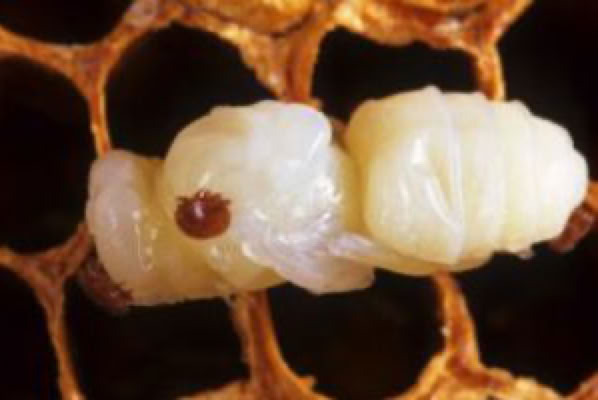
Use Caution During Inspections: Possible brood issues may exists if beekeepers see signs of these diseases, such as: sunken, perforated capped brood, or ropy larvae,
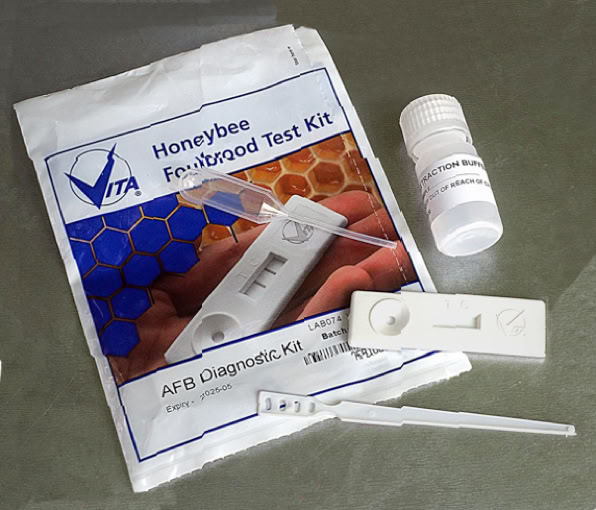
Testing for American Foul-brood (AFB) and European Foul-brood (EFB)
There are test kits available from most bee supply companies that will allow beekeepers to test for these diseases, view video from Honey Bee Honey.